
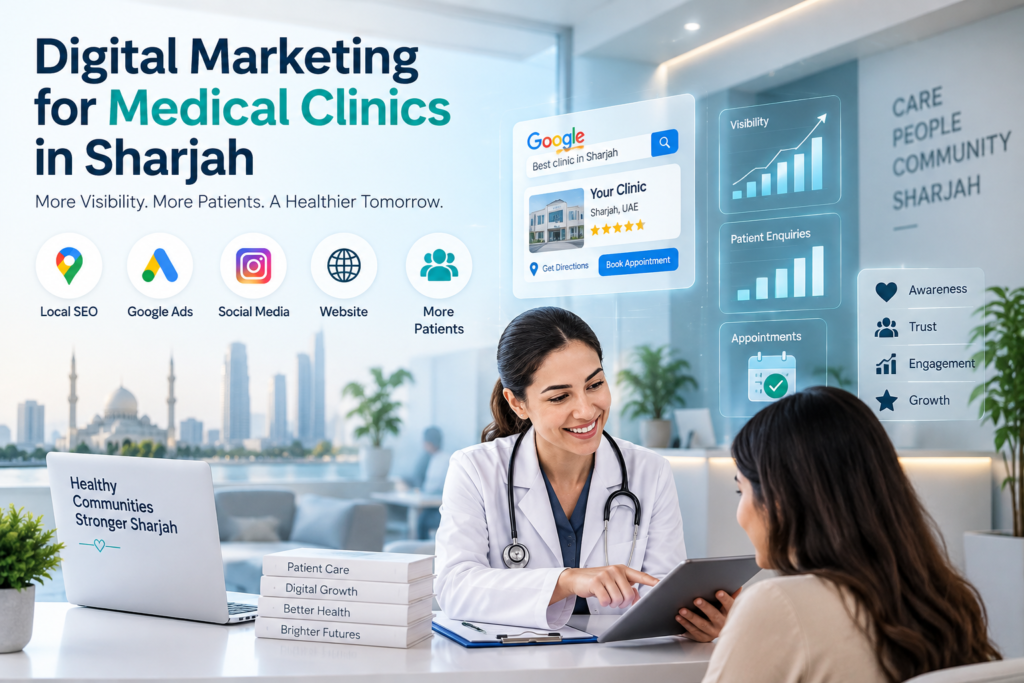
Digital marketing for medical clinics in Sharjah is not simply about posting treatment photos on Instagram or running Google Ads. A clinic needs to reach patients who are looking for the right service, give them enough information to make an informed decision and make it easy to book an appointment.
Consider a patient looking for a dermatologist in Sharjah. They may search Google, compare nearby clinics, read reviews, check doctors’ qualifications and visit several websites before calling.
If your clinic is difficult to find, has an outdated website or takes too long to respond to enquiries, that patient may book elsewhere.
A practical medical marketing strategy connects all these steps. It brings relevant people to your clinic, helps them understand your services and gives your reception team a clear process for turning enquiries into appointments.
For medical, dental, dermatology and aesthetic clinics in Sharjah, here is what deserves attention.
Why Digital Marketing for Medical Clinics in Sharjah Is Different
Healthcare marketing is different from marketing an ordinary retail product.
Patients are making decisions about their health, appearance, comfort and safety. They need accurate information, professional credibility and confidence that their concerns will be handled appropriately.
A clinic also operates within healthcare advertising rules. Its marketing must account for the services it is licensed to provide, the accuracy of medical claims, patient privacy and any required advertising approvals.
In the UAE, the Ministry of Health and Prevention provides a health-advertisement licensing service covering relevant advertising channels and electronic platforms. Clinics should check the requirements that apply to their facility, service, advertisement and licensing authority before publishing promotional material.
This does not mean medical marketing has to be complicated. It means the strategy should be built around useful information and a trustworthy patient experience rather than exaggerated promises.
1. Start With Google Maps and Local SEO
When someone searches for a nearby clinic, Google Maps may be one of the first places they look.
Searches could include:
- Dermatologist in Sharjah
- Dental clinic in Al Majaz
- Medical centre near Al Nahda Sharjah
- Aesthetic clinic in Sharjah
- Paediatric clinic near me
These searches indicate that the person is looking for a service in a particular area. For many clinics, that makes local search an important source of enquiries.
Your Google Business Profile should contain the correct clinic name, category, address, opening hours, phone number, website and relevant services.
Add genuine photographs of your clinic, reception area, treatment rooms and team where appropriate. Make sure the map location is accurate and the appointment link works.
Google states that its local search results are primarily influenced by relevance, distance and prominence. Complete business information and genuine reviews can help a clinic present itself more clearly, but paying for advertising does not buy a higher organic Maps ranking.
What should a Sharjah clinic do first?
Search for your clinic as a patient would.
Check whether its business profile appears, whether the location is correct and whether the website and contact buttons work.
Then search for your main services in your area.
If your clinic provides dermatology, dentistry and general medicine, make sure those services are accurately represented on your website and business profile. Avoid adding services that your facility does not actually offer.
Useful resource: Google’s guide to improving local rankings.
2. Build a Website That Helps Patients Book
A clinic website should do more than look attractive.
It needs to answer the questions patients have before making an appointment.
For example, someone considering a dermatology consultation may want to know whether the clinic provides that service, which doctors are available, where the clinic is located and how to book.
If the website makes them search through several pages to find a phone number, it creates unnecessary friction.
A useful medical clinic website should include clear service pages, doctor profiles, clinic location, opening hours and prominent appointment options.
Each service page should explain what the service involves, who may need an assessment, what patients can generally expect and when they should speak to a qualified professional.
For treatments where suitability varies, the website should make that clear rather than promising a particular result.
Example: A dermatology service page
Instead of placing every dermatology treatment on one long page, a clinic could create dedicated pages for services it actually provides.
A page about acne consultations might explain the clinical assessment, possible treatment approaches, the importance of individual medical history and how to arrange an appointment.
A page about laser treatments could explain the equipment or treatment types offered, the consultation process, important suitability considerations and general aftercare information.
The content should be reviewed by an appropriately qualified clinician before publication.
For clinics that want a clearer patient journey, FAMS Solutions provides website design and development services.
3. Use Google Ads for Relevant Patient Searches
Google Ads can help a clinic appear for relevant searches while its organic visibility develops.
For example, a clinic offering dental consultations may want to reach people searching for dental services in its actual catchment area.
The important part is matching the advertisement to the patient’s search.
An advertisement about dental consultations should lead to a relevant dental page, not an unrelated homepage.
The landing page should make the next step obvious: call the clinic, view its location or request an appointment.
Do not send every advertisement to the homepage
Imagine a patient searching for a specific dermatology service.
They click an advertisement and arrive at a homepage showing general information about the clinic. They then have to find the dermatology section, locate the relevant treatment and search for the booking number.
A dedicated service page can make that journey simpler.
It can provide the information the patient was looking for and place an appointment button near the relevant content.
Healthcare advertising policies matter
Google has specific healthcare and medicines advertising policies. Some healthcare-related products and services face restrictions, and certain advertisements require certification or are limited by location. Advertisers must also comply with applicable local laws.
Google additionally restricts personalized advertising based on sensitive health interests. That includes certain medical conditions and procedures, including some cosmetic procedures and injections.
A clinic should therefore review the rules before launching treatment-specific campaigns. An advertising approach that works for a restaurant or furniture shop may not be permitted for a healthcare service.
Useful resources: Google’s healthcare advertising policy and health-related personalized advertising restrictions.
4. Use Instagram to Explain Services and Build Familiarity
Instagram can help prospective patients become familiar with a clinic before contacting it.
However, posting every day is not necessarily a marketing strategy.
A clinic may publish frequently and still receive few useful enquiries if its content does not answer patient questions or explain its services.
A more practical approach is to organize content around the information patients need.
For example, a dermatology clinic could publish clinician-reviewed explanations of common skin concerns, consultation processes, general treatment information and questions patients can discuss with their dermatologist.
A dental clinic might introduce its team, explain what happens during a first consultation and provide general oral-health education.
A medical centre could show its facilities, introduce licensed professionals and explain how patients can book the appropriate department.
For a Sharjah audience, consider providing content in both Arabic and English where appropriate.
Avoid turning every post into an offer
If every post says “Book now” or “Limited-time discount,” the account may provide little information to someone who is still evaluating their options.
Educational content can help a patient understand a service before deciding whether to arrange a consultation.
Promotional material should be checked against applicable healthcare advertising requirements, especially when it includes treatment claims, patient imagery, testimonials or offers.
Patient photos and stories should never be treated as ordinary marketing assets. Obtain appropriate consent, protect confidential information and confirm that the proposed content is permitted before publishing it.
5. Build Trust Through Doctors, Reviews and Accurate Information
A patient deciding between clinics may look for information about the people who will provide their care.
That makes doctor profiles an important part of the website.
A useful profile can include the professional’s name, qualifications, specialty, relevant experience, languages spoken and appointment details. These details should be accurate and consistent with the professional’s current licensing and credentials.
Genuine patient reviews can also help people understand experiences such as appointment handling, communication and the clinic environment.
But a clinic should never publish fabricated reviews or pressure patients to leave positive feedback.
When responding to public reviews, avoid confirming that a reviewer is a patient or disclosing details of their treatment. Even a well-intentioned reply can create a privacy problem.
A neutral response can acknowledge feedback and invite the person to contact the clinic privately.
The goal is to show that the clinic takes communication seriously without discussing medical information in public.
6. Make WhatsApp and Appointment Enquiries Easier to Manage
Many clinics put a WhatsApp button on their website and assume that is enough.
It is a useful contact option, but it does not solve problems in the booking process.
Consider what happens after someone clicks.
Does the message reach the right reception team? Does someone respond during working hours? Can the team identify which department the person needs? Is there a process for following up when an appointment has not been confirmed?
A good enquiry process makes those responsibilities clear.
For example, a general medical centre might use a simple initial message asking which department the person wants to contact. Reception staff can then provide appropriate booking information or arrange a callback.
Avoid requesting unnecessary medical details through an ordinary marketing enquiry form. Patients should be directed to the clinic’s approved communication and clinical systems when sensitive information is required.
Track enquiries without confusing clicks with appointments
A WhatsApp button click is not the same as a booked appointment.
A person may click the button but never send a message. They may send a message but decide not to book.
The clinic should distinguish between website activity, actual enquiries, confirmed appointments and attended appointments.
That makes it easier to understand whether marketing is helping the business.
For more on enquiry journeys, explore FAMS Solutions and its website and digital marketing services.
7. Measure Appointments, Not Just Advertising Clicks
A clinic can receive a large number of website visits without seeing a meaningful increase in appointments.
This is why reporting needs to follow the patient journey beyond the advertisement.
A practical marketing report should show how many relevant enquiries were received, how many appointments were confirmed, which services people asked about and where the enquiries originated.
It should also identify operational problems.
For example, if an advertising campaign generates enquiries but the clinic frequently misses calls, increasing the advertising budget may not solve the real problem.
Google Ads supports different conversion actions, including website actions and phone calls. It also offers options to connect offline outcomes to advertising data, where the setup and applicable privacy requirements allow.
A clinic can use this information alongside its own appointment records to make better decisions.
Useful resource: Google Ads conversion measurement guidance.
What About Marketing for Aesthetic Clinics in Sharjah?
Aesthetic clinics often have a different customer journey from general medical centres.
Someone researching an aesthetic treatment may spend more time comparing providers, understanding the procedure, reviewing qualifications and considering whether the treatment is appropriate for them.
That makes clear educational content and professional credibility particularly important.
Aesthetic clinic marketing should explain the consultation process, treatment options, possible limitations and relevant safety information without suggesting that a result is guaranteed.
It should not use unsupported claims or pressure people into treatment.
Advertisements for cosmetic procedures may also face additional platform restrictions. The clinic should have its proposed campaigns and creative materials reviewed for the rules that apply to its services and licensing authority.
Common Digital Marketing Mistakes Medical Clinics Make
One mistake is running advertisements before fixing the website. If visitors cannot find the right doctor, service or appointment button, additional traffic may produce little benefit.
Another is focusing entirely on followers and views. These can provide useful context, but they do not reveal whether enquiries are relevant or whether appointments are being booked.
Clinics also sometimes promote too many unrelated services in one campaign. A clearer approach is to organize campaigns around actual departments and services, with relevant information on each landing page.
Finally, marketing and reception teams need to communicate. If the marketing report says a campaign generated 50 enquiries but reception records only 20, both teams should investigate the difference before deciding what to change.
How Much Should a Medical Clinic Spend on Digital Marketing?
There is no single budget that suits every clinic.
A new clinic with limited brand awareness may need a different plan from an established medical centre with several departments and a strong referral network.
Costs also depend on the services being promoted, competition in the clinic’s area, the number of landing pages required and whether the clinic needs help with content, website improvements or lead tracking.
Instead of choosing a budget based only on what other clinics spend, start with the clinic’s operational capacity and commercial goals.
If reception can handle only a limited number of new enquiries each day, marketing should be planned around that reality.
If the clinic wants to expand a particular department, it should first confirm that the required staff, appointment slots and service information are available.
Marketing works better when it reflects what the clinic can actually deliver.
How FAMS Solutions Supports Medical Clinics in Sharjah
FAMS Solutions provides digital services for UAE businesses, including medical and aesthetic clinics that need a stronger online presence.
For a clinic, the work may involve improving its website, creating clearer service pages, developing a local SEO plan, managing relevant digital campaigns and building a better route from online enquiry to appointment.
The first step is understanding where the existing process is losing patients.
A clinic that is difficult to find on Google needs a different plan from one that receives regular enquiries but has a poor booking process.
FAMS can help assess the website, digital presence and enquiry journey before recommending the next steps.
Explore FAMS Solutions’ website design services or contact FAMS Solutions to discuss your clinic’s requirements.
Final Thoughts
Effective digital marketing for medical clinics in Sharjah connects visibility, patient information and appointment handling.
Google Maps helps nearby patients find the clinic. A clear website helps them understand the services. Relevant advertising can reach people searching for care. Educational content introduces the team and answers common questions. A reliable enquiry process helps patients take the next step.
None of these channels works particularly well when treated in isolation.
For a clinic, the most useful marketing question is not simply, “How many people saw our advertisement?”
It is, “Did we help the right patients find accurate information and make it easier for them to arrange appropriate care?”
That is the foundation of a more sustainable medical marketing strategy.