
AI adoption in the UAE has moved beyond experimentation.
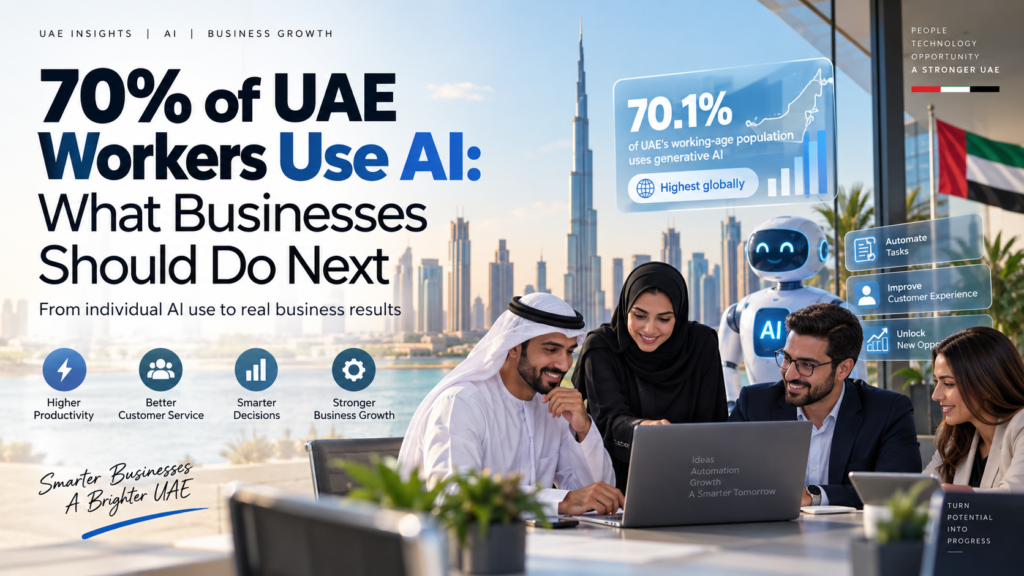
Microsoft’s Q1 2026 Global AI Diffusion Report says 70.1% of the UAE’s working-age population is using generative AI, the highest rate reported globally. The UAE is also the first economy in the report to cross the 70% threshold.
That changes the question for businesses.
The issue is no longer simply:
“Should we use AI?”
The more useful question is:
“How do we turn widespread AI use into better customer service, faster operations, stronger decisions and measurable business results?”
For UAE companies, especially SMEs, this is where the real opportunity begins.
Why AI Adoption UAE Businesses See Matters
High adoption does not automatically mean high business value.
People may already be using AI for:
- Writing emails
- Summarizing documents
- Creating content
- Research
- Customer replies
- Presentations
- Data analysis
- Everyday admin work
But individual usage is different from building a proper AI-enabled business process.
Microsoft UAE has recently emphasized exactly this point: the next stage is not simply getting more people to use AI, but helping organizations turn that capability into measurable productivity, better decisions and repeatable business outcomes.
1. Start With a Business Problem, Not an AI Tool
One of the biggest mistakes companies make is buying AI tools first and asking what to do with them later.
A better approach is to identify the problem.
For example:
- Customer replies take too long
- Sales leads are not followed up properly
- Quotations take hours to prepare
- Reports are created manually
- Staff repeats the same admin tasks every day
- Marketing content takes too much time
Then ask whether AI can reduce that work.
Microsoft UAE’s current guidance is similar: companies should start with a clear business problem and measurable outcome rather than an “AI budget.”
That is a much healthier approach for SMEs.
2. Use AI to Improve Customer Response Time
Customer service is one of the easiest places to start.
A business may receive repetitive questions such as:
- What are your prices?
- What are your working hours?
- Do you deliver?
- Where are you located?
- How long does the service take?
- Can I get a quotation?
AI can help prepare answers, summarize customer needs and organize enquiries.
The important point is control.
AI should use approved business information.
It should not invent prices, promises or policies.
For example, a UAE clinic could use AI to help categorize enquiries.
A printing company could use it to prepare standard quotation information.
A web agency could use it to summarize project requirements before a salesperson responds.
3. Improve Sales Follow-Up
Many businesses lose leads because follow-up depends on memory.
A customer asks for pricing.
The salesperson replies.
The customer becomes busy.
Nobody follows up.
AI can help by:
- Summarizing previous conversations
- Preparing follow-up messages
- Identifying unanswered leads
- Suggesting next actions
- Categorizing opportunities
A useful workflow could be:
Website enquiry → lead recorded → AI summary → salesperson assigned → follow-up prepared
This is much more valuable than simply using AI to write social media captions.
If you want to build the full system, read our guide on Lead Generation UAE.
4. Use AI for Repetitive Administration
Many SME employees handle several roles at the same time.
A single person may deal with:
- Sales
- Customer service
- Invoices
- Reports
- Marketing
- Quotations
AI can reduce some of that repetitive work.
Useful tasks include:
- Meeting summaries
- Draft emails
- Proposal first drafts
- Spreadsheet summaries
- Customer notes
- Task extraction
- Internal documentation
Microsoft’s 2026 Work Trend Index argues that as AI and agents take on more execution, people can spend more time on direction, judgment and outcomes.
That is particularly relevant to small businesses with limited teams.
5. Move Beyond Individual AI Use
This is one of the most important next steps.
If every employee uses AI separately, the company may get some productivity benefit.
But the bigger opportunity comes when AI becomes part of the workflow.
For example:
Before
Customer sends enquiry
Employee reads it
Employee creates notes
Employee sends quotation request internally
Employee manually follows up
After
Customer sends enquiry
System records it
AI summarizes requirements
Salesperson receives structured information
Quotation draft is prepared
Follow-up is scheduled
This is where AI begins to create operational value.
Microsoft describes this shift as moving toward more AI-enabled or “Frontier” firms, where humans remain responsible for direction and decisions while AI handles more execution.
6. Improve Decision-Making With Existing Data
Many UAE businesses already have useful data.
It may be sitting in:
- Excel files
- CRM systems
- Google Analytics
- Accounting software
- Ad platforms
- Customer databases
The problem is that nobody has enough time to analyze it.
AI can help answer questions such as:
- Which service generates the most revenue?
- Which marketing source produces the best leads?
- Which customers have not been contacted recently?
- Which expenses increased this month?
- Which website pages generate enquiries?
The data still needs to be accurate.
AI cannot compensate for poor records.
But when the information is organized properly, AI can make analysis much faster.
7. Build AI Into Your Website Carefully
A website is another area where businesses can use AI.
Possible applications include:
- Customer question assistance
- Lead qualification
- Service recommendations
- Search
- Content personalization
- Form summarization
But do not add AI simply because it looks modern.
If the website is slow, confusing or poorly structured, a chatbot will not fix it.
Start with a strong digital foundation.
You can read our guide on AI-Ready Website UAE.
8. Create Clear AI Rules Inside the Business
As AI becomes more common, businesses need simple internal rules.
Employees should know:
- What information can be uploaded
- What customer data is sensitive
- Which tools are approved
- Which outputs need human review
- Who is responsible for final decisions
This becomes especially important for:
- Healthcare
- Finance
- Legal services
- HR
- Customer data
- Confidential business documents
Microsoft’s 2026 responsible AI reporting emphasizes that trust, governance and reliable use become more important as AI spreads deeper into normal work.
AI adoption without basic governance can create unnecessary risk.
9. Train Staff on Real Workflows
Generic AI training is often too broad.
Showing employees 100 prompts is less useful than teaching them how to improve one real task.
For example:
Marketing team:
How to turn one service brief into campaign content
Sales team:
How to summarize enquiries and prepare follow-ups
Operations:
How to turn meeting notes into tasks
Management:
How to analyze monthly performance data
Training becomes more useful when it is connected directly to work.
10. Measure Business Results
Do not measure AI success by:
- Number of AI accounts
- Number of prompts
- Number of tools purchased
- Number of AI pilots
Measure outcomes.
Examples:
- Response time reduced from 30 minutes to 10
- Proposal preparation reduced from two hours to 30 minutes
- More leads followed up
- Fewer repetitive admin hours
- Faster reporting
- Better customer response rates
Microsoft UAE has recently made the same argument: AI should be judged by improved business outcomes and whether those outcomes can be repeated responsibly.
What Does 70.1% AI Adoption Actually Mean?
It is important to interpret the number correctly.
Microsoft’s measure refers to the share of the working-age population using generative AI, not the percentage of UAE companies that have fully integrated AI into their operations.
That distinction matters.
A person using ChatGPT to rewrite an email counts as AI usage.
That does not mean their company has redesigned its workflows around AI.
This is exactly why businesses still have a large opportunity.
The UAE may already be leading in individual adoption, but many organizations are still in the early stages of turning that usage into structured business value.
Why SMEs Have a Big Opportunity
Large organizations have technology teams, consultants and large budgets.
Small businesses often do not.
But SMEs also have an advantage.
They can sometimes change faster.
A small company can test a new lead process next week.
A large company may require months of approvals.
Microsoft UAE has identified SMEs and entrepreneurs as an important part of the next stage of AI adoption in the country.
For SMEs, the best approach is usually:
Start small.
Solve one real problem.
Measure the result.
Then expand.
A Practical AI Plan for a UAE Small Business
A simple first-month plan could look like this:
Week 1: Identify three repetitive tasks.
Week 2: Choose one task with low risk and high repetition.
Week 3: Test an AI-assisted workflow.
Week 4: Compare time, quality and output with the old process.
If the workflow improves the result, document it.
Then move to the next task.
That is more useful than subscribing to every new AI tool that appears.
How FAMS Solutions Approaches AI for UAE Businesses
At FAMS Solutions, we look at AI as part of the broader digital system.
That may include:
- Website
- Lead capture
- Customer enquiries
- Digital marketing
- Reporting
- AI visibility
- Automation
- Business workflows
The objective is not to add AI everywhere.
It is to identify where technology can reduce friction or help the business operate more effectively.
You can explore FAMS Solutions here:
For more practical examples, see:
and:
Final Thoughts
AI adoption UAE businesses are seeing is already exceptionally high.
Microsoft’s latest data shows 70.1% of the UAE’s working-age population using generative AI, far above the global figure of 17.8% reported for Q1 2026.
That means the next competitive advantage will probably not come from simply saying:
“Our company uses AI.”
The advantage will come from using AI better.
Better customer response.
Better follow-up.
Better reporting.
Less repetitive work.
Faster decision-making.
Stronger workflows.
The UAE has already demonstrated that people are willing to adopt AI.
Now businesses need to turn that adoption into real business value.