
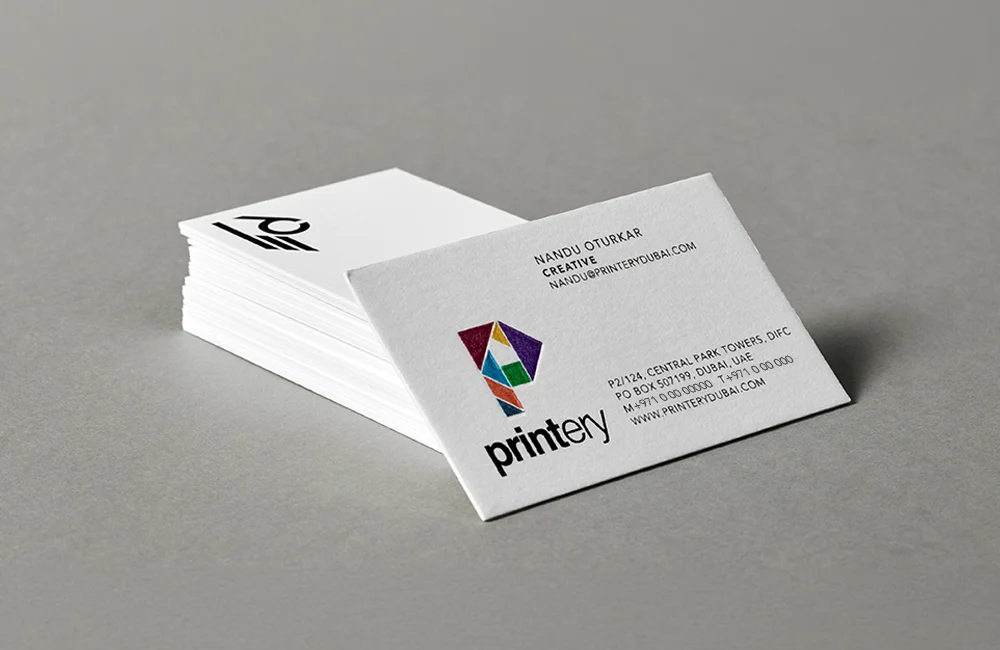
If you are comparing visiting card printing UAE prices, you will notice that the cost can vary quite a lot depending on paper quality, quantity, finishing, design, and whether you want a standard card or something more premium.
For a new business, visiting cards are usually one of the first printed items ordered after the logo and brand identity are finalized. They are still commonly used in meetings, exhibitions, sales visits, networking events, and day-to-day business introductions across the UAE.
At FAMS Solutions, 1,000 standard visiting cards are available for AED 250, making them a practical option for startups and businesses that need professional cards without paying premium-printing prices.
But price alone should not be the only thing you compare.
This guide explains what affects business-card printing cost, what you should check before ordering, and when it is worth paying more for premium finishes.
What Is the Average Visiting Card Printing UAE Businesses Pay?
There is no single fixed market price.
The final cost usually depends on:
- Quantity
- Paper GSM
- Single or double-sided printing
- Lamination
- Matt or glossy finish
- Rounded corners
- Spot UV
- Foil
- Embossing
- Design work
- Delivery
- Turnaround time
A basic card printed in bulk will normally cost much less per card than a small premium batch.
That is why comparing only the total price can be misleading.
For example, 1,000 standard visiting cards for AED 250 works out to just AED 0.25 per card.
A premium card with foil, thick stock, special texture or custom cutting may cost several times more.
Why Quantity Changes the Price
Printing becomes more cost-effective when ordered in larger quantities.
The setup required for printing 100 cards is not dramatically different from printing 1,000 cards, which is why the cost per card usually drops as quantity increases.
That means businesses that regularly attend meetings or distribute cards may get better value from larger print runs.
However, do not over-order if your information may change soon.
If your:
- Phone number
- Job title
- Website
- Company address
is likely to change, printing thousands of cards can create unnecessary waste.
1. Paper Quality Affects Visiting Card Printing Cost
Paper thickness is one of the first things people notice when holding a card.
Business-card paper is commonly measured in GSM — grams per square metre.
Higher GSM generally means a thicker and more substantial card.
Canva, for example, groups business-card paper into lighter standard stocks around 240–325 GSM, premium stocks around 325–350 GSM, and much heavier deluxe options.
For a normal professional business card, you do not always need the thickest paper available.
The right choice depends on your brand.
A small service company may prefer a clean, professional standard card.
A luxury real-estate, jewellery, or premium hospitality brand may benefit from a thicker stock.
2. Matt vs Glossy Lamination
Finishing changes both the look and feel of the card.
Matt lamination gives a softer and more understated appearance.
It is often used for:
- Consultants
- Corporate companies
- Agencies
- Professional services
Glossy lamination reflects more light and can make colors and photos appear more vivid.
It can work well for:
- Retail
- Beauty
- Food businesses
- Photography-heavy designs
There is no universally better option.
The finish should match the design.
3. Double-Sided Printing Usually Makes More Sense
Trying to fit every piece of information on one side often makes a business card look crowded.
A better layout may use:
Front:
Logo and company identity.
Back:
Name, phone, email, website, job title, QR code.
This keeps the design cleaner.
Many modern printers include full-color double-sided printing as a standard option. MOO, for example, offers full-color printing on both sides across its two-sided business-card range.
4. Special Finishes Increase the Price
Premium finishing can make a card more memorable.
Options can include:
- Gold foil
- Silver foil
- Spot UV
- Embossing
- Debossing
- Raised print
- Textured stock
- Rounded corners
These treatments increase production cost.
They should therefore be used where they actually support the brand.
A gold-foil business card can look excellent for a luxury company.
The same finish may be unnecessary for a small maintenance business that needs 5,000 cards for regular distribution.
5. Design Quality Matters as Much as Printing
A premium printer cannot rescue a weak design.
Your card should be readable within seconds.
A professional card normally needs:
- Logo
- Person’s name
- Job title
- Phone
- Website
You may also include:
- QR code
- Social profile
- Office location
Avoid putting too much information on a small card.
MOO recommends keeping artwork high-resolution and using 300 dpi for photographic or non-vector print artwork so details remain sharp.
That matters because a design that looks fine on a phone screen may appear blurred or pixelated after printing.
What Is the Standard Business Card Size?
One common international business-card size is approximately 3.5 × 2 inches, or about 89 × 51 mm. MOO and Canva both list this as a commonly used standard format.
However, exact sizes can vary by market and printer.
Some printers use formats closer to:
85 × 55 mm
or:
90 × 50 mm
Always ask your printer for the final artwork dimensions before submitting the design.
You should also allow for:
- Bleed
- Trim area
- Safe area
This prevents logos or text from being cut too close to the edge.
How Much Should a Startup Spend on Visiting Cards?
A new company usually does not need an expensive luxury card immediately.
Your first card should be:
Professional
Readable
Consistent with your branding
Properly printed
For many startups, 1,000 visiting cards for AED 250 is enough to create a professional first batch while keeping the budget under control.
Later, if the brand moves more premium, you can upgrade to:
- Thick card stock
- Foil
- Spot UV
- Special textures
- Custom shapes
Start with function.
Upgrade when the brand requires it.
When Is Premium Business Card Printing Worth It?
Premium printing makes more sense when the card itself plays an important role in how your business is perceived.
Examples include:
- Luxury real estate
- Architecture
- Interior design
- Premium consulting
- High-end retail
- Jewellery
- Hospitality
- Executive services
In these industries, the card may become part of the brand experience.
For a delivery business or high-volume sales operation, standard printing may be more practical.
Should You Add a QR Code?
Yes, if the QR code has a clear purpose.
It can link to:
- Website
- Portfolio
- Google Maps
- Contact details
- Digital profile
A QR code is particularly useful because it connects a physical card to your digital presence.
Do not add one simply because it looks modern.
The destination should actually help the person receiving the card.
Printed Card or NFC Card?
This is becoming another useful choice for UAE businesses.
A printed card is inexpensive and easy to hand over.
An NFC business card is reusable and can open a digital profile with a tap.
For professionals who network regularly, both can work together.
You might use:
Printed cards for distribution
and
One NFC card for meetings
Taps, for example, allows professionals to share a digital profile through NFC, QR, or a direct link.
You can explore it here:
Visiting Card Printing UAE by FAMS Solutions
FAMS Solutions provides business-card design and printing for UAE businesses.
Our standard offer includes:
1,000 visiting cards — AED 250
This is suitable for:
- Startups
- Consultants
- SMEs
- Sales teams
- New companies
- Existing businesses updating their branding
You can explore our full printing service here:
FAMS also provides:
- Company stamps
- Letterheads
- Corporate stationery
- Branding
- Logo design
- Company profiles
- Websites
- Startup packages
You can explore all services at:
What Should You Check Before Ordering?
Before confirming your printing order, check the final proof carefully.
Make sure:
- Name spelling is correct
- Phone number is correct
- Email works
- Website is correct
- Job title is correct
- QR code works
- Logo is high resolution
- Colors match your brand
- Bleed is correct
- Safe margins are respected
A typo on 1,000 cards is much more expensive than spending two extra minutes checking the proof.
Common Visiting Card Printing Mistakes
One common mistake is making the text too small.
Another is using low-resolution artwork.
Businesses also sometimes add too many services, social links, addresses, and taglines until the card becomes difficult to read.
The best business cards are usually simple.
They answer:
Who are you?
What company are you with?
How can I contact you?
Everything else is optional.
Final Thoughts
The cost of visiting card printing UAE businesses pay depends on quantity, paper, finish, design, and printing method.
For most startups and SMEs, a standard professional card is enough.
You do not need expensive foil or extremely thick card stock simply to look professional.
Good branding, readable information, quality artwork, and clean printing matter more.
At FAMS Solutions, 1,000 standard visiting cards are available for AED 250, giving UAE businesses an affordable way to maintain a professional physical identity.
If your brand needs something more premium, the card can then be upgraded with heavier paper, special finishes, QR, or even NFC.
The right card is not necessarily the most expensive one.
It is the one that represents your business properly.