
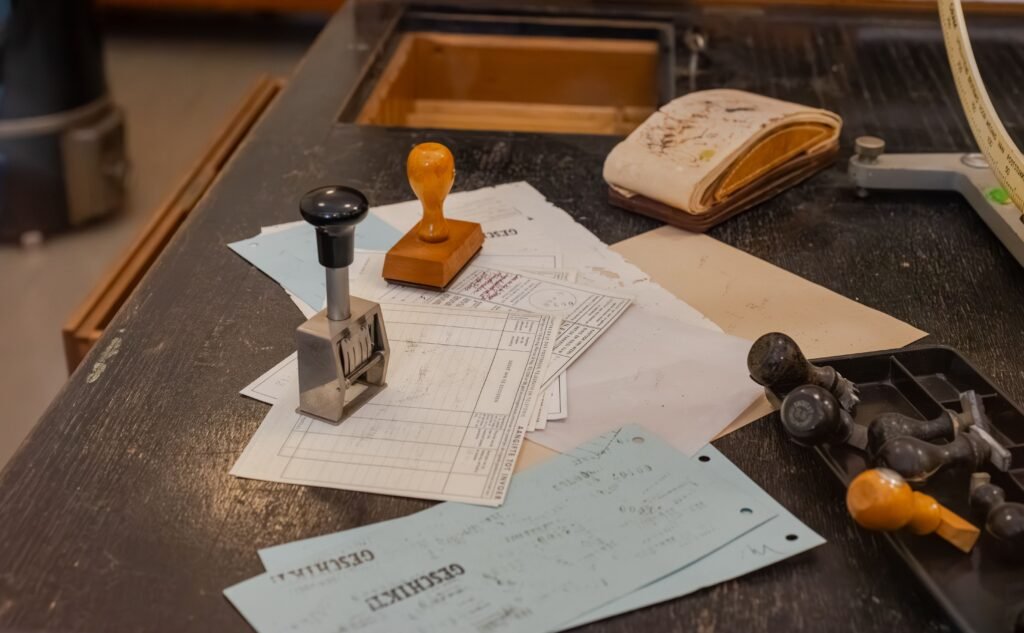
A Company Stamp UAE businesses use may seem old-fashioned in an increasingly digital business environment.
Companies now sign documents electronically, submit government applications online, send invoices through accounting systems and increasingly exchange documents without printing anything.
So a reasonable question for a new UAE business owner is:
Do I actually still need a company stamp?
In practice, company stamps remain common in the UAE.
You may be asked to stamp declarations, applications, purchase orders, letters, contracts or other business documents depending on the authority, bank, free zone, customer or transaction involved.
However, there is an important distinction:
Not every business document automatically requires a company stamp simply because you operate in the UAE.
Requirements vary depending on the document and the authority involved.
That is why it is useful to have a properly prepared company stamp available—even if you do not stamp every document your company produces.
What Is a Company Stamp?
A company stamp is a physical stamp carrying identifying information about a business.
It is sometimes called a:
- Company seal
- Business stamp
- Corporate stamp
- Official stamp
- Rubber stamp
In everyday UAE business use, companies commonly use the stamp alongside an authorised person’s signature.
For example, a document might contain:
Authorised Signatory
Signature
Company Stamp
The stamp helps connect the signed document to the company issuing or approving it.
It does not automatically replace the authority of the person signing the document.
That distinction matters.
A person still needs the appropriate authority to sign on behalf of the company where the transaction requires an authorised signatory.
Is a Company Stamp Mandatory in the UAE?
This question does not have a simple yes-or-no answer for every company and every document.
Requirements depend on the company’s jurisdiction, licensing authority and the particular transaction.
For example, DMCC has published company-stamp guidance stating that its licensed companies should have a company stamp and that the company name should correspond with the licence.
At the same time, UAE tax rules demonstrate why you should not assume that every business document needs a stamp.
The Federal Tax Authority’s VAT rules specify the mandatory information that a full tax invoice must contain—including the supplier’s name, address, TRN, invoice number, date, description, amounts and VAT information. A company stamp is not included in that standard list of mandatory invoice particulars.
So the better answer is:
A company stamp remains important and is required or requested in certain UAE processes, but you should check the specific requirement for the document you are dealing with.
A Real Example: The FTA Still Requests Stamped Documents
The continued use of stamps is not simply tradition.
There are current government processes where stamped documents are specifically requested.
For example, the Federal Tax Authority’s VAT-registration requirements state that certain applicants may need to provide an official declaration letter showing taxable supplies and monthly sales that is stamped and signed by the authorised signatory.
The FTA also lists supporting documents such as expected-revenue purchase orders or contracts that may need to be duly stamped and signed.
That is a good example of why a newly established company may want its stamp ready even if most daily communication happens electronically.
Federal Tax Authority — VAT Registration Requirements
When Is a Company Stamp UAE Businesses Use Still Useful?
There are several situations where having a company stamp available can make business administration easier.
The exact requirement should always be confirmed with the organisation receiving the document.
1. Government and Regulatory Applications
Some government, free-zone or regulatory processes may request a document to be both signed and stamped.
This can include:
Declarations.
Letters.
Applications.
Supporting documentation.
Authorisation letters.
Forms.
The requirement varies between authorities.
Do not assume that because one authority accepted an electronically signed document, another authority will follow exactly the same process.
If an application says:
“signed and stamped”
provide both.
2. Tax Registration and Supporting Documents
As mentioned above, some FTA processes specifically refer to stamped and signed documentation.
For a new business this may become relevant when dealing with:
VAT registration.
Declarations.
Revenue evidence.
Contracts.
Purchase orders.
Other supporting documentation requested during an application.
This is one of the practical reasons we recommend preparing your company stamp soon after receiving the trade licence rather than waiting until an authority asks for it urgently.
3. Bank-Related Documents
Banks increasingly use digital processes, but company documentation requirements still vary significantly.
Depending on the bank and transaction, a business may be asked to provide signed company documents, declarations, instructions or other authenticated paperwork.
Whether the bank specifically requires a stamp should be confirmed directly with that bank.
Do not stamp something simply because:
“This is what we always do.”
Instead, follow the bank’s actual instructions.
That avoids documents being rejected because they were completed incorrectly.
4. Contracts and Agreements
Companies often stamp contracts alongside the authorised signatory’s signature.
This is common business practice.
However, a stamp should not be treated as a substitute for checking:
Who is authorised to sign?
Does the agreement require notarisation?
Does it require witnesses?
Does the company’s constitutional documentation impose signing rules?
Does the other party specifically require a company seal?
For higher-value contracts, legal advice may be appropriate.
A AED 100 rubber stamp should never be treated as a replacement for understanding the legal authority behind a AED 1 million agreement.
5. Purchase Orders
Purchase orders are another common place where company stamps appear.
A supplier may ask for a PO that contains:
Company name.
PO number.
Date.
Items/services.
Amounts.
Authorised signature.
Company stamp.
This can be especially common where businesses still use manual procurement processes.
Again, requirements vary by organisation.
6. Quotations and Supplier Documents
Some customers ask suppliers to stamp quotations before accepting them into their procurement systems.
That does not necessarily mean UAE law requires every quotation to carry a stamp.
It may simply be the customer’s internal procedure.
If your customers regularly ask for stamped quotations, having the stamp ready saves time.
7. Authorisation Letters
Businesses sometimes prepare letters authorising employees, managers or representatives to perform certain tasks.
Depending on the purpose and receiving organisation, the letter may be requested on:
Company letterhead.
With an authorised signature.
And with the company stamp.
These three things together help clearly identify where the letter came from.
8. Employee and HR Documents
Certain HR documents, letters or applications may also be requested with the company stamp depending on the government authority, free zone, employer procedure or third party receiving the document.
The UAE has increasingly digitised employment procedures, so do not automatically stamp every HR document.
Follow the specific procedure you are using.
9. Supplier Registrations
Large companies frequently have supplier-onboarding procedures.
You may be asked to provide:
Trade licence.
VAT certificate.
Bank details.
Company profile.
Authorised signatory information.
Stamped declaration.
Signed supplier-registration form.
Having your company stamp ready can make these registrations much faster.
10. Tender and Procurement Documents
Businesses participating in tenders may encounter sections specifically asking for:
Signature.
Company stamp.
Initials.
Supporting certificates.
This is particularly important because missing a small administrative requirement can cause an otherwise good submission to be rejected.
Always follow the tender instructions exactly.
Does a UAE Tax Invoice Need a Company Stamp?
This is an important myth to clear up.
A company stamp is not listed as one of the standard mandatory particulars of a UAE VAT tax invoice under the FTA’s Article 59 invoice requirements.
The required details include information such as:
The words Tax Invoice.
Supplier name and address.
Supplier TRN.
Customer information where applicable.
Unique invoice number.
Invoice date.
Supply date where different.
Description of goods/services.
Amounts.
VAT rate.
VAT amount.
A company stamp is not listed among those standard mandatory fields.
That means you should not tell customers:
“A tax invoice is legally invalid unless it has a stamp.”
That statement would be too broad.
Some customers may nevertheless request stamped invoices for their own internal accounting or procurement process.
That is different from saying the VAT legislation universally requires the stamp.
Federal Tax Authority — VAT Rules and Guidance
Should You Stamp Every Invoice Anyway?
You can if it forms part of your company’s internal process, but it is not always necessary.
For a small company issuing five invoices each month, manually stamping invoices may not be difficult.
For a business issuing 5,000 invoices through an accounting system, manually stamping every invoice would make little operational sense unless there is a specific requirement.
The UAE is also moving further toward structured electronic invoicing.
The FTA describes e-Invoicing as the electronic creation and exchange of structured invoice data between suppliers and buyers, with reporting to the tax authority.
That illustrates the broader direction of business administration:
more digital, more structured and less dependent on physical paper.
But until every business process is completely digital, the humble company stamp is unlikely to disappear immediately.
What Should a Company Stamp UAE Businesses Use Contain?
The safest approach is to base the stamp on your official trade licence information.
The most important element is usually the company’s legal name.
Do not casually shorten or alter it.
For example, if the trade licence says:
ABC Technical Services LLC
do not create a stamp saying:
ABC Services
unless your relevant authority specifically allows that format.
DMCC’s published guidelines, for example, say the company name on the stamp should match the name appearing on the licence.
Depending on your jurisdiction and chosen design, a stamp may contain:
Legal company name
Arabic company name where required/applicable
Emirate / UAE
And potentially other identifying information if appropriate.
Do not overload the stamp with unnecessary information.
Its purpose is identification, not advertising.
Should the Stamp Be in Arabic and English?
Many UAE company stamps are bilingual.
For some jurisdictions or company types this may be the expected format.
The safest approach is to reproduce the legal company naming information as it appears in your official licensing documents and follow any requirements issued by your licensing authority.
Do not translate your legal business name yourself if an official Arabic name already appears on your trade licence.
Use the licensed wording.
That avoids mismatches later.
Should You Put the Trade Licence Number on the Stamp?
Some companies include it.
Others do not.
Whether it is required will depend on the particular authority or format applicable to your company.
Do not assume that every piece of information visible on the trade licence belongs on the stamp.
A clean company stamp should remain easy to read when printed on:
Contracts.
Invoices.
Letters.
Forms.
Purchase orders.
A stamp containing too much tiny information often produces poor results.
Round Stamp or Rectangular Stamp?
Both are commonly used.
There is no universal marketing reason one shape is superior.
A round stamp often gives a traditional official-seal appearance.
A rectangular stamp gives more room for company information.
The better choice depends on:
Your company’s legal name length.
Arabic and English requirements.
Amount of information.
Where the stamp will normally be used.
For most businesses, readability matters more than shape.
What Colour Should the Company Stamp Be?
Blue ink is very commonly used in business environments because it is easy to distinguish an original stamped document from a black-and-white copy.
But do not assume a particular colour is legally mandatory for every UAE business.
If a bank, authority or customer specifies a colour or format, follow its requirement.
Otherwise, choose something practical and readable.
Can You Put Your Logo on a Company Stamp?
Technically, many stamp designs can include a logo.
Whether you should depends on the purpose.
An official business stamp should prioritise:
company identification
over
decoration.
If adding a logo makes the company name tiny or unreadable, remove it.
The stamp is not a miniature advertisement.
Company Stamp vs Company Seal: Are They the Same?
In everyday business conversations, people often use terms such as company stamp and company seal interchangeably.
Legally, however, particular jurisdictions can use more precise terminology.
For example, ADGM’s company regulations contain specific provisions relating to companies that have a common seal and official seals.
That is different from simply assuming every rubber office stamp has the same legal meaning as a formal corporate seal under every legal framework.
For ordinary SMEs, the practical question is usually:
“What does the authority/customer require on this document?”
Follow that requirement rather than debating terminology.
Does the Company Stamp Make a Contract Legal?
Not by itself.
This is a dangerous misunderstanding.
Imagine an employee with no authority takes the company’s rubber stamp and applies it to an agreement.
The existence of the stamp alone does not automatically answer questions such as:
Was the employee authorised?
Was the document properly signed?
Did the company’s constitutional documents permit the transaction?
Were other legal formalities required?
For example, ADGM’s notary guidance specifically explains that simply appearing on a company’s commercial licence does not by itself necessarily establish authority to sign documents for notarisation; signing authority may derive from company regulations, power of attorney or a shareholder/board resolution.
The stamp supports authentication and business procedure.
It does not replace proper signing authority.
Protect Your Company Stamp
This is a simple operational point many small businesses overlook.
Do not leave the company stamp in an open office drawer where everyone can use it.
Decide who controls it.
For example:
Owner.
General Manager.
Accounts Department.
Authorised administrator.
Consider maintaining a simple process for sensitive documents.
If your company regularly handles high-value contracts, financial instructions or official documents, knowing who can use the stamp becomes more important.
A company stamp should be treated as a business control—not as stationery available to everyone.
What If the Stamp Is Lost?
If your company stamp is lost or stolen, treat it seriously.
Inform relevant internal staff.
Review whether any sensitive documents could have been stamped without permission.
Contact your licensing authority, bank or legal adviser where appropriate to determine whether any formal action is required.
Then replace the stamp and consider changing the design if there is a genuine misuse risk.
The precise steps will depend on the company and jurisdiction.
When Should a New UAE Company Make Its Stamp?
Ideally, soon after receiving the trade licence.
There is little advantage in waiting until:
a bank requests it,
the accountant needs it,
a supplier-registration deadline arrives,
or an authority asks for a stamped declaration.
A company stamp is relatively simple to prepare compared with many other startup tasks.
For a new business, the practical sequence often looks like:
Trade licence
→
Company stamp
→
Business bank/accounting setup
→
Domain and email
→
Website
→
Business stationery
→
Marketing
Having these basics ready makes the company much easier to operate.
What Documents Should You Bring to Make a Company Stamp?
Requirements will depend on the stamp provider and your licensing authority.
Normally, the starting point should be your current valid trade licence so that the company name can be reproduced accurately.
Do not send a company-stamp provider a name typed into WhatsApp and assume that is sufficient.
Use the licensed company information.
This is particularly important where:
LLC,
FZE,
FZCO,
Branch,
or other legal-form wording forms part of the official company name.
Avoid This Common Company Stamp Mistake
A founder receives a trade licence.
The licence says:
ABC BUSINESS CONSULTANCY L.L.C
They tell the printer:
“Make ABC CONSULTANCY.”
The stamp arrives.
Later, the bank or customer compares it with the licence.
The names do not match.
Now another stamp needs to be made.
Save yourself the trouble.
Send the actual trade licence.
Confirm the spelling.
Confirm Arabic and English wording.
Then manufacture the stamp.
Company Stamp UAE for Startups
A new startup already has dozens of things to organise.
Company stamp.
Business cards.
Letterhead.
Domain.
Business email.
Email signature.
Website.
Logo.
Social media.
Google presence.
Marketing materials.
This is why FAMS Solutions approaches these requirements as connected parts of a new company’s business setup rather than isolated printing jobs.
You should not need to search for:
one company for the stamp,
another person for business cards,
another developer for the website,
another provider for professional emails,
and somebody else for branding.
FAMS Solutions provides business branding, websites, digital marketing and printing services for UAE companies.
Company Stamp and Your Corporate Stationery Should Match
Once your trade licence has established the correct company name, use it consistently.
The same company identity should appear across:
Company stamp.
Letterhead.
Visiting card.
Quotation.
Invoice.
Website.
Email signature.
Company profile.
Social media.
Consistency makes administration easier and makes the company look more professional.
If your stamp says one business name, invoice says another and website uses a third variation, customers can become confused.
Company Stamp + Visiting Cards + Letterheads
For many new UAE companies, the stamp is only one part of the initial printing requirement.
You may also need:
Visiting cards.
Letterheads.
Folders.
Envelopes.
Company profile printing.
Marketing material.
QR business cards.
These materials should ideally use the same approved identity from the beginning.
FAMS Solutions provides printing services for UAE businesses, including visiting cards and company stationery.
FAMS Solutions — Printing Service UAE
Do Digital Businesses Still Need a Physical Company Stamp?
Sometimes, yes.
Imagine a software company.
Its website is digital.
Contracts are digital.
Invoices are digital.
Payments are digital.
Team is remote.
You may think there is absolutely no reason for a physical stamp.
Then six months later:
a bank,
customer,
government authority,
tax application,
supplier-registration process,
or procurement department
asks for one document:
“Signed and stamped.”
At that point, a stamp that has sat unused in a drawer for six months suddenly becomes useful.
That is why the question should not necessarily be:
“Will I use this every day?”
Instead ask:
“Will there be situations where having it immediately available saves time?”
For many UAE companies, the answer is yes.
Will Company Stamps Disappear in the Future?
Probably from some processes.
The UAE continues to digitalise government and business administration.
Tax is one example.
The Federal Tax Authority’s e-Invoicing programme describes a future built around structured electronic invoice exchange and automated reporting rather than traditional paper documents.
Digital signatures, portals, authentication systems and electronic approvals will continue reducing the need to physically stamp routine paperwork.
But business systems do not all change at the same speed.
Government agencies.
Free zones.
Banks.
Procurement departments.
Small businesses.
Large corporations.
International suppliers.
They may all use different procedures.
So the company stamp remains a useful bridge between traditional and digital business administration.
Frequently Asked Questions About Company Stamp UAE
Is a company stamp mandatory in UAE?
Requirements vary according to the company’s jurisdiction and the particular document or transaction.
Some authorities and free zones specifically require or expect company stamps for certain purposes. DMCC, for example, has published guidance addressing company-stamp requirements for its licensed companies.
Always verify the requirement with your licensing authority or the organisation receiving the document.
Do UAE invoices require a company stamp?
A company stamp is not listed among the standard mandatory particulars of a VAT tax invoice under Article 59 of the UAE VAT Executive Regulations.
A customer may nevertheless request a stamped invoice as part of its own internal process.
Does an invoice need a signature?
The standard VAT tax-invoice requirements list the required invoice particulars and do not list a signature among the standard mandatory fields.
Other contractual, commercial or customer-specific requirements may still apply.
Do I need a company stamp for VAT registration?
Certain FTA VAT-registration supporting documents may specifically need to be stamped and signed. For example, the FTA lists an official taxable-supplies declaration letter that must be stamped and signed by the authorised signatory among relevant application documents.
What should I put on my UAE company stamp?
Start with the exact legal company name shown on your trade licence and follow any additional requirements imposed by your licensing authority.
Should the company stamp be Arabic and English?
Bilingual stamps are common, and certain jurisdictions may have specific requirements. Use the official company naming details from your licence rather than creating an unofficial translation.
Can I put my company logo on the stamp?
It may be possible, depending on the design and jurisdiction, but readability and correct company identification should be the priority.
Can anyone in the company use the stamp?
From an internal-control perspective, businesses should restrict access to appropriate staff. A stamp should not be treated as proof that every person possessing it has authority to commit the company.
Can I order a company stamp immediately after getting my trade licence?
Yes. In fact, this is usually the most practical time because your official company details have been finalised and you may soon need stamped documents for banking, accounting, tax, customers or suppliers.
Company Stamp UAE: A Simple Checklist
Before ordering your company stamp, check:
Current trade licence
Exact English company name
Official Arabic company name where applicable
Legal suffix such as LLC/FZE/FZCO where applicable
Licensing-authority requirements
Correct emirate/location wording where required
Readable stamp size
Appropriate authorised person controlling the stamp
That simple check can prevent unnecessary reprinting later.
How FAMS Solutions Can Help
Getting a company stamp should not become another complicated startup task.
At FAMS Solutions, we can prepare a professional company stamp using your UAE business details and help with the other materials your new company needs.
That can include:
Company stamps.
Visiting cards.
Letterheads.
Branding.
Logo design.
Business stationery.
Professional business emails.
Website design and development.
Digital marketing.
The idea is simple.
You have already spent time getting the trade licence.
Now the company needs everything required to look and operate like a real business.
FAMS Solutions helps put those pieces together.
FAMS Solutions — UAE Business, Branding, Web & Printing Services
Final Thoughts
A Company Stamp UAE business keeps in the office may not be used every day anymore.
That does not mean it has become useless.
UAE business processes are becoming increasingly digital, but there are still situations where government authorities, tax processes, banks, customers, procurement departments or other organisations may request documents that are signed and stamped.
The important thing is not to misunderstand what the stamp does.
It does not automatically make every document legally valid.
It does not replace an authorised signatory.
And it is not universally required on every invoice or quotation.
It is simply one of the practical tools a UAE company should have available when a process requires it.
If you have just received your trade licence, prepare the stamp correctly from the beginning.
Use the exact company details.
Keep it secure.
And then move on to the things that help customers actually recognise your new business:
your branding,
website,
business email,
stationery,
and online presence.
For a new UAE company, those small pieces together create something much bigger:
a business that is ready to operate professionally from day one.